
Calcium Citrate Liquid Drops vs Tablets: Elemental Calcium, Serving Size & D3 + K2 Label Guide
Quick Answer
Calcium citrate drops and tablets can use the same calcium form but still differ greatly in serving size, elemental calcium per serving, added vitamin D3 or K2, and package quantity. Compare the Supplement Facts panel rather than assuming a liquid and tablet with the same front-label milligrams provide the same amount.
What Does “Calcium Citrate” Tell You—and What Does It Not Tell You?
Calcium citrate identifies the calcium compound used in the formula. It does not, by itself, tell you the amount of elemental calcium, the serving size, or whether the product includes vitamin D3, vitamin K2, or other nutrients.
For a comparison of calcium forms, read Calcium Citrate vs Calcium Carbonate.
What Is Elemental Calcium on a Supplement Label?
The Supplement Facts panel reports the amount of calcium that counts as the nutrient amount per serving. This is more useful for comparison than relying on the total weight of the calcium compound or a large number printed on the front of the package.
Why front-label numbers can be confusing
A front panel may emphasize a compound weight, serving amount, or marketing statement. The Supplement Facts panel is where you confirm the calcium amount and % Daily Value associated with one serving.
How Do Liquid Drops and Tablets Differ?
Serving measurement
Liquid products may use mL, droppers, or another measured volume. Tablets use a count such as one or two tablets per serving.
Package size
A 30 mL bottle and a 90-tablet bottle describe package quantity, not nutrient dose. Compare servings per container to understand how many labeled servings the package provides.
Other ingredients
Liquids may contain flavors, carriers, or sweeteners, while tablets may use binders, coatings, or other excipients. See Other Ingredients on Supplement Labels.
How Do D3 + K2 Change a Calcium Formula?
When vitamin D3 and K2 are included, the product becomes a multi-nutrient formula. Compare each nutrient separately and check whether you also get D3 or K2 from other supplements.
Read Vitamin D3 + K2 Supplement Labels: IU, mcg, %DV & Combined Formula Differences and Can You Take Multiple Supplements with Vitamin D3 + K2?.
How Does the Luvixy Calcium Product Fit This Comparison?
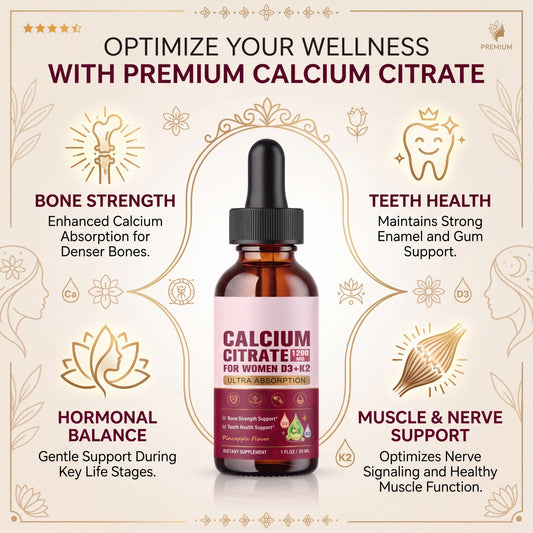
Luvixy Calcium Citrate 1200 mg with D3 + K2 for Women – 30 mL Drops is a liquid formula, so the key comparison points are the measured serving, nutrient amounts per serving, total bottle volume, and added D3 + K2.
Browse related products in Women’s Wellness.
How Do You Compare a Liquid Calcium Product With a Tablet Product?
Step 1: Match the serving basis
Compare one labeled serving with one labeled serving, not one dropper with one tablet unless those are the stated serving sizes.
Step 2: Compare calcium per serving
Use the calcium line on the Supplement Facts panel.
Step 3: Compare added nutrients
Check vitamin D3, vitamin K2, magnesium, or other minerals separately.
Step 4: Compare servings per container
This helps distinguish package size from nutrient strength.
Frequently Asked Questions
Are calcium citrate drops stronger than tablets?
Not automatically. Strength depends on the amount of calcium per serving, not the physical format.
Does 1200 mg always mean 1200 mg of elemental calcium?
Do not assume that from the front label alone. Verify the calcium amount on the Supplement Facts panel.
Does a 30 mL bottle mean 30 servings?
Not necessarily. Divide the total bottle volume by the labeled serving volume to estimate servings, or use the servings-per-container statement when provided.
Can a calcium formula also contain vitamin D3 and K2?
Yes. In that case, compare all three nutrients and check for overlap with other supplements.
Where can I compare liquid supplements with capsules or tablets more generally?
Educational content only. If you have questions about calcium intake, kidney health, medications, or vitamin K and anticoagulant therapy, discuss supplement use with a qualified healthcare professional.
Tags:
Previous
L-Tyrosine in Thyroid Support Supplements: How to Read Amounts, Serving Size & Ingredient Overlap
Next
What Does “Odorless” Aged Garlic Mean? Aging, Fermentation, Softgels & Label Questions