
What Does “Nano” Mean in a Liquid Supplement? Delivery Claims, Particle Size & Evidence
Quick Answer
Direct answer: the word “nano” on supplement marketing does not, by itself, prove a specific particle size, better absorption, greater potency, or a better health outcome. The useful questions are what material is being described, how it was measured, whether the finished product has relevant evidence, and whether the claim is clearly explained.
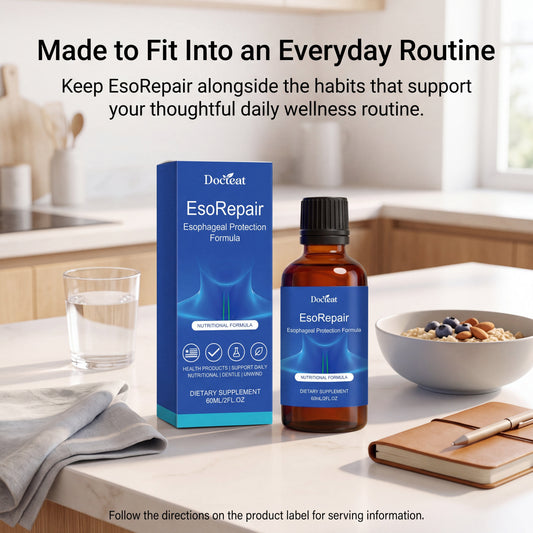
Some liquid-wellness products use advanced-delivery language. Shoppers comparing products such as Esophage Daily Esophageal Wellness Liquid and Docteat EsoRepair Esophageal Wellness Formula should separate bottle-format convenience from evidence about the actual delivery system.
What does “nano” mean in FDA guidance?
Direct answer: FDA does not use one simple marketing definition for every product. Its nanotechnology guidance identifies materials with dimensions in approximately the 1–100 nanometer range as one important consideration and also looks at whether engineered materials show dimension-dependent properties or biological effects.
FDA addresses safety, effectiveness, quality, and regulatory questions about nanotechnology products case by case. That is different from saying every product using the word “nano” has been reviewed or proven to perform better.
Does nano automatically mean better absorption?
Direct answer: no. Smaller particle size or a delivery system can change physical properties, but a front-label term cannot substitute for finished-product evidence.
Bioavailability depends on the ingredient, formulation, dose, manufacturing process, digestion, and study design. A claim such as “advanced delivery” should be evaluated separately from a claim that the product produces a specific health outcome.
What should a shopper ask when a supplement uses nano language?
- What exactly is nano-sized? The active ingredient, a carrier, an emulsion, or another component?
- Is a particle-size range disclosed? Marketing language alone may not answer this.
- Is the technology described for the finished product?
- Are bioavailability claims supported by human data for the same formulation?
- Are wellness claims being confused with treatment claims?
Nano vs liposomal: are they the same?
Direct answer: no. “Nano” and “liposomal” describe different concepts and should not be treated as interchangeable.
Liposomal formulations use lipid-based structures, while nanotechnology is a broader term that can involve nanoscale materials or dimension-dependent properties. Read What Does Liposomal Mean in Supplements? for a separate explanation.
Does a 60 mL nano liquid contain a stronger dose than a 30 mL product?
Direct answer: no. Bottle volume does not tell you dose strength, particle size, absorption, or effectiveness.
Use the serving size, amount per serving, servings per container, directions, and formulation details. See 30 mL vs 60 mL Supplement Drops.
Why product-specific evidence matters
A study on one nano-emulsion, nanoparticle, drug-delivery system, or liposomal preparation cannot automatically prove the same result for a different retail supplement. Ingredient evidence, delivery-system evidence, and finished-product evidence are separate layers.
For esophageal-wellness products, also keep category language separate from treatment claims. Read Esophageal Wellness Liquid Supplements: What to Look For.
Frequently asked questions
Does FDA have one legal definition of nanotechnology for all supplements?
FDA guidance provides considerations for identifying applications of nanotechnology, but the agency states that the guidance does not establish a single regulatory definition and that issues are evaluated case by case.
Is nano the same as micronized?
No. The terms refer to different size ranges and processing concepts. Do not treat them as synonyms unless the manufacturer clearly defines its terminology.
Can a nano supplement treat reflux or esophageal disease?
A dietary supplement should not be presented as a treatment for GERD, esophagitis, or another disease unless it meets the applicable evidence and regulatory requirements for such claims.
What is the best evidence to look for?
Evidence using the same finished formulation, dose, route, and measured outcome is more informative than a general study on a different nanomaterial or ingredient.
Related Luvixy reading
- Liquid Drops vs Capsules
- How to Read a Supplement Facts Label
- Digestive & Liver Support Supplements: A Practical Guide
Evidence & references
- U.S. FDA — Considering Whether an FDA-Regulated Product Involves the Application of Nanotechnology
- U.S. FDA — Nanotechnology Guidance Documents
Educational content only. A delivery-technology term should not be used as a shortcut for proven clinical benefit.
Related application: See how delivery claims fit into a full liquid-label comparison in Esophageal Wellness vs Digestive Support Supplements.
Related application: See how delivery claims should be separated from dose in EsoRepair vs Esophage Daily.
Tags:
Previous
What Does “Proprietary Blend” Mean on a Supplement Label? How to Read Total Blend Weight
Next
Other Ingredients on Supplement Labels: Gelatin, Flavors, Carriers & Excipients Explained