
Calcium Citrate with Vitamin D3 + K2: A Women’s Wellness Guide
Quick Answer
Key takeaway: calcium, vitamin D, and vitamin K have different nutritional roles. Vitamin D supports calcium absorption, while vitamin K is involved in normal blood clotting and bone-related proteins. A combined formula can be convenient, but the right amount depends on total intake from food and supplements—not the front-label number alone.
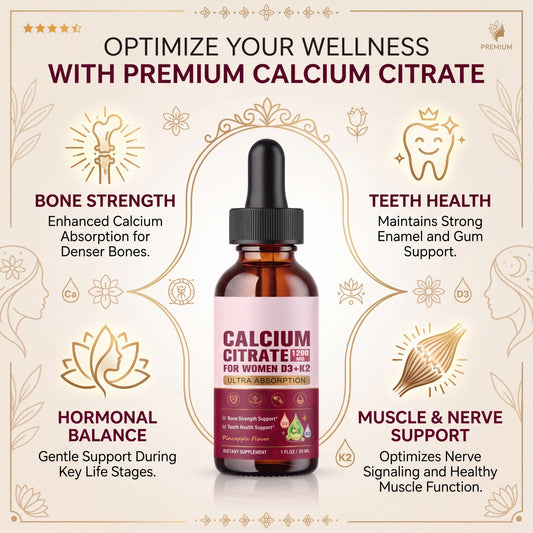
This guide uses Luvixy Calcium Citrate 1200 mg with D3 + K2 for Women – 30 mL Drops as an example of a liquid mineral formula.
What is calcium citrate?
Calcium citrate is a calcium salt used in dietary supplements. When comparing calcium products, look for the amount of elemental calcium shown on the Supplement Facts panel rather than assuming the weight of the entire calcium compound is the amount of calcium you receive.
The U.S. FDA’s supplement-labeling guidance specifically distinguishes the weight of calcium itself from the weight of its source compound on the Supplement Facts panel.
What does vitamin D3 do in a calcium formula?
Vitamin D helps the body absorb calcium and supports normal bone mineralization. Vitamin D3 is one form used in supplements. The NIH Office of Dietary Supplements notes that vitamin D status and needs can vary with age, sun exposure, diet, skin pigmentation, health conditions, and other factors.
Why is vitamin K2 included?
Vitamin K is required for normal blood clotting and is involved in proteins related to bone. K2 refers to a family of vitamin K forms known as menaquinones. Its presence in a calcium formula does not mean that more K2 is always better or that the combination prevents osteoporosis.
Important: people taking warfarin or similar vitamin K–antagonist anticoagulants should keep vitamin K intake consistent and discuss supplements containing vitamin K with their healthcare professional.
Calcium citrate vs other calcium forms
Different calcium salts contain different percentages of elemental calcium and can have different practical considerations. Calcium citrate is often used because it can be taken with or without food, while calcium carbonate is generally absorbed best when taken with food. Individual tolerance and the labeled dose still matter.
Liquid calcium drops vs tablets
| Format | Practical advantage | What to check |
|---|---|---|
| Liquid drops | No large tablet to swallow | Measured serving, flavor, storage, concentration |
| Tablets/capsules | Portable and pre-portioned | Tablet size, elemental calcium per serving, serving count |
Format alone does not determine whether one product is superior. Choose a format you can use correctly and consistently.
Total calcium intake matters
Calcium supplements add to calcium obtained from food. More is not automatically better. Review dairy foods, fortified plant beverages, tofu, canned fish with bones, leafy greens, and other dietary sources alongside supplements.
Taking large supplemental amounts at once may also be less useful than dividing intake depending on the product and total amount. Follow the product directions and professional advice when applicable.
How this fits with other women’s wellness products
If you use a product such as Pureveen Thyroid Balance Liquid Drops or a multivitamin, compare minerals and vitamins across labels. Some minerals can also interfere with the absorption of certain medications, including thyroid medication, so medication timing may need professional guidance.
For the thyroid category, see Thyroid Support Nutrients: Selenium, Zinc, Iodine & More.
Frequently asked questions
Is calcium citrate the same as vitamin D3?
No. Calcium is a mineral; vitamin D3 is a vitamin. They perform different biological roles.
Does a calcium + D3 + K2 supplement prevent osteoporosis?
A dietary supplement should not be presented as a guarantee that it prevents or treats osteoporosis. Bone health depends on total nutrition, physical activity, age, hormones, medical conditions, and other factors.
Should I take vitamin K2 if I use warfarin?
Do not make major vitamin K changes without medical guidance. Warfarin’s effect is sensitive to vitamin K intake, so consistency and clinician oversight are important.
Evidence & references
- NIH Office of Dietary Supplements — Calcium Fact Sheet
- NIH Office of Dietary Supplements — Vitamin D Fact Sheet
- NIH Office of Dietary Supplements — Vitamin K Fact Sheet
Related Luvixy reading
See How to Read a Supplement Facts Label and Wellness Supplements by Goal.
Reviewed and updated by the Luvixy Wellness Team for general educational purposes. If you are pregnant, nursing, taking medication, or managing a medical condition, ask a qualified healthcare professional before adding a new supplement.
More nutrient-overlap guides
- Can You Take Multiple Supplements with Vitamin D3 + K2?
- What Is Magnesium Glycinate? How to Read Magnesium Forms
- Why Are Zinc and Copper Paired in Supplements?
Related deep dive: calcium form comparison
Comparing citrate with another common calcium form? Read Calcium Citrate vs Calcium Carbonate: Absorption, Serving Size & Label Differences for a direct comparison of elemental calcium, food timing, serving size, and label interpretation.
Related Luvixy reading: Learn how to compare the nutrient lines in Vitamin D3 + K2 Supplement Labels. Product example: Calcium Citrate with D3 + K2 Drops.
New related guide: Compare physical formats and elemental-calcium labeling in Calcium Citrate Liquid Drops vs Tablets. Product example: Calcium Citrate with D3 + K2 Drops.
Tags:
Previous
Amla and PDRN: Building a Daily Beauty & Glow Routine
Next
Soursop (Graviola) Drops: What They Are and What to Look For